





















Throwing light on sunscreen
How to pick the best SPF and what to consider. Let’s answer some FAQs about sunblock and UV protection…

Safe sun exposure and Vitamin D – essential for life!
SPF aka Sun Protection Factor can feel like an absolute minefield, and can be so confusing and overwhelming that it can feel easier just to not bother applying any at all. Today at SVR we are going to unpick suncare and safe sun exposure. Let us de-mystify some of the jargon and bust some myths.

How is Sun Protection Factor (SPF) measured anyway?
In an attempt to standardise sunscreen protective capabilities, “SPF” ratings categorise levels of protection. Regardless what sunscreen you use, you will still be getting sun exposure and SPF simply refers to the extra time you can stay in the sun before you start to burn. Despite SPF being the universal “gold standard” measuring system for suncare, most people don’t realise that it only measures protection against UVB (“burning” rays), not UVA (classically thought of as the “aging” rays). Since no one filter can completely protect, each sunscreen usually contains a combination of filters that work together like an orchestra of instruments, to deliver the optimum result. That’s why broad spectrum sun protection is crucial. You want to know that your skin is protected from different types of ray.
SPF measurement involves comparing the Minimal Erythema Dose (MED) of skin that is protected by sunscreen, to the MED of unprotected skin. The MED refers to the smallest dose of UV radiation that causes mild sunburn.
The SPF number is calculated by dividing the MED of protected skin by the MED of unprotected skin. For example, if it takes 30 times longer for sunscreen-protected skin to redden compared to unprotected skin, the SPF is 30.
Myth busting time...
FACT: SPF 30 blocks approximately 97% UVB whereas SPF 50 is only about 1% more (~98%). Application quantity and reapplication matter far more than chasing higher numbers. Above SPF50+, the irritation risk starts to outweigh the tiny gain in protection.
FACT: Unless you’re applying a full teaspoon of foundation… it’s not. SPF in makeup is a nice bonus, not your main protection.
FACT: Melanin helps, but it doesn’t make you invincible. Burning, hyperpigmentation and skin cancer can still occur, so SPF is for every skin tone.
FACT: UVA rays penetrate clouds and windows, so your skin is still getting hit even on grey days and through glass.
What’s the best way to actually use SPF?
- Use SPF 30–50 broad-spectrum every day, all year round.
- Reapply every 2 hours.
- Use the 2-finger rule for face, neck and décolleté.
- Use at least an egg-cup full quantity for body.
- Choose reef-safe formulations — they tend to be gentler on you, too.


Should we be afraid of light?
Absolutely not. Light is essential for life and for vitamin D synthesis. Red light is shown to have lots of great health benefits. Blue light in excess, on the other hand, is bad for our health — and all tech emits blue light constantly. Night-time scrolling on our phones or lying in bed with a laptop doesn’t just contribute to “tech neck”, it exposes your freshly cleansed, unprotected skin to polluting, damaging blue light with no SPF to filter it out.
What about sunglasses?
Wearing sunglasses all the time can hamper your skin’s melanin production response, as your eyes need to absorb some rays to trigger the body’s natural protection mechanisms. It’s good to give your eyes a break for short intervals (without looking directly into the sun) to allow this response to kick in.

What should I look for and what should I avoid in suncream?
Ingredient quality, biodegradability and toxicity are major considerations. Endocrine disruption from toxic chemicals in clothing, food packaging and cosmetics (including suncare) can lead to ill health and, with repeated exposure, to genetic mutations and cancer.
Endocrine disruptors
Oxybenzone, Benzophenone-3, Octinoxate, Ethylhexyl Methoxycinnamate*, Homosalate*, Octyl Salicylate, Ethylhexyl Salicylate*, Octocrylene, filters containing nanoparticles*.
Eco-toxic filters
Oxybenzone, Benzophenone-3, Octinoxate / Ethylhexyl Methoxycinnamate*, Homosalate*, Octocrylene, filters containing nanoparticles*.
Irritants
Octinoxate, Ethylhexyl Methoxycinnamate*, Octocrylene.

Natural, non-toxic & coral-safe sunscreen ingredients
Non-nano Zinc Oxide, Non-nano Titanium Dioxide, Red Raspberry Seed Oil, Carrot Seed Oil, Shea Butter, Coconut Oil, Moringa Oil, Jojoba Oil, Aloe Vera Extract, Sea Buckthorn Oil, Green Tea Extract, Sunflower Seed Oil.
Vitamin D: don’t forget the sun itself
Vitamin D is vital for bone and immune health, among other things. Aim for short, safe bursts of real, unfiltered sunlight on your skin daily if you can, before applying your sunscreen.
What about seed oils?
Many seed oils are highly processed and rich in omega-6 fatty acids. They’re thought to be inflammatory and may promote ill health as well as increased sensitivity to sunlight. What you put into your body is just as important as what you put on your skin.
Which format should I pick?
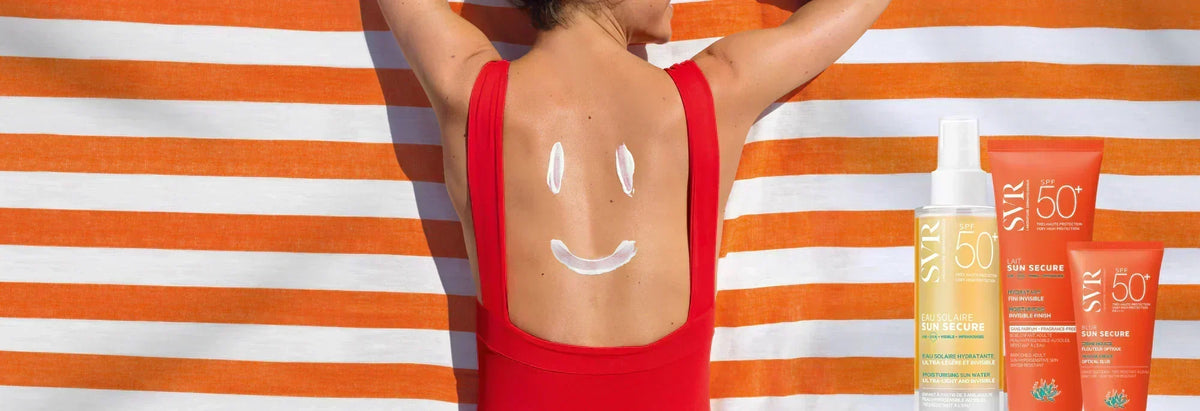
Spray, cream, milk, gel, oil… sun protection only works if you actually apply it. Overcoming sunscreen reluctance is a huge part of how we formulate at SVR — especially for kids.
- Lots of kids and a lot of surface area to cover? Fizzy Milk SPF50+, Sun Water SPF50+(rated in 'Best sunscreens for kids' by 'Hello!'), Mist SPF50.
- Dry, depleted skin? Reach for Milk SPF50+, Cream SPF50+, Dry Oil SPF50.
- Tend to get sweaty / fussy about residue and slide? Sun Water SPF50+ or SPF30, Extreme SPF50+ are ideal.
Here’s a summary to help you pick the right sunscreen for you
Compare textures, skin needs and formats across the full SVR Sun Secure range.
Discover the full SVR Sun Secure range here.


Find one formula you actually like wearing — texture, finish, and scent matter. The “best” SPF is the one you’ll put on every morning without a debate.” — SVR / Natalie Di Giorgio